Food Crisis 2026: Why Vertical Farming Is Becoming a Structural Solution
The global food crisis in 2026 is no longer driven by a single factor. It is the result of a chain reaction across energy markets, fertilizer supply, logistics, and geopolitical instability. What we are seeing is not a temporary disruption - it is a structural shift in how food is produced, priced, and distributed.
March 30, 2026 20:13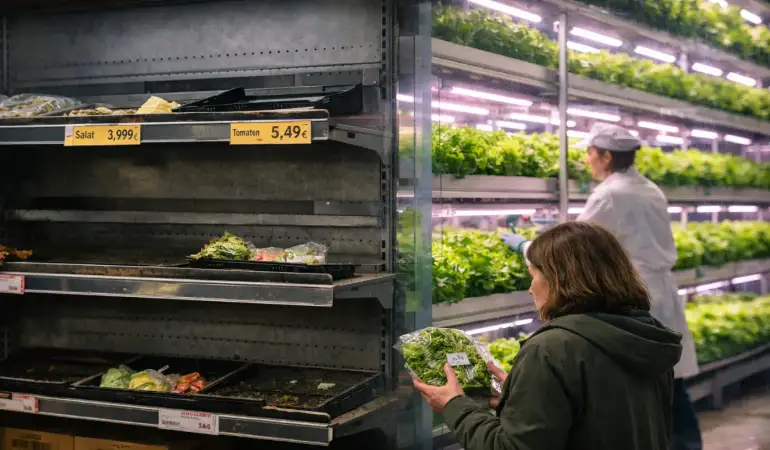 Recent data shows that nearly half of consumers are already struggling to afford food, highlighting how deeply the crisis is affecting daily life.
👉
Read the full food affordability study
Recent data shows that nearly half of consumers are already struggling to afford food, highlighting how deeply the crisis is affecting daily life.
👉
Read the full food affordability study
The Real Driver: Energy and Fertilizer Dependency
One of the most critical drivers of the food crisis is fertilizer dependency. Modern agriculture relies heavily on nitrogen-based fertilizers, which are directly linked to natural gas prices.
Geopolitical tensions are now putting this system under pressure again. The Middle East plays a central role in global fertilizer supply, and disruptions in this region can affect both availability and pricing.
👉 Read more about the global fertilizer crisis
This is especially critical because fertilizers are directly tied to energy markets. Nitrogen production depends on natural gas, meaning that rising gas prices quickly translate into higher agricultural costs.
The Chain Reaction Behind Rising Food Prices
The relationship between energy, fertilizers, and food prices is direct:
- Energy prices rise → fertilizer production becomes more expensive
- Fertilizer prices rise → farming costs increase
- Fuel prices rise → transport becomes more expensive
- Supply chain risks increase → food prices rise
At the same time, farmers are unable to fully pass these costs on, which reduces profitability and creates pressure across the entire system.
In extreme cases, fertilizer shortages can even reduce yields, leading to lower production and higher consumer prices.
Food Affordability Is Already a Structural Problem
Food affordability is no longer limited to low-income households. Even higher-income groups are increasingly concerned about grocery prices.
This shows that the food crisis is not only about production - it is also about economic accessibility and system stability.
Why Traditional Agriculture Alone Cannot Solve This
Traditional agriculture depends on multiple unstable variables:
- Fertilizer imports
- Fuel and machinery
- Global logistics
- Climate conditions
When all of these factors become volatile at the same time, the system becomes fragile.
Vertical Farming as a Structural Food Crisis Solution
Vertical farming addresses the weakest points of the current food system by enabling local, controlled, and predictable food production.
- Reduced dependency on global supply chains
- Production close to urban demand
- Controlled environment independent of climate
- Precise input management
The Hidden Key: Precision Nutrition
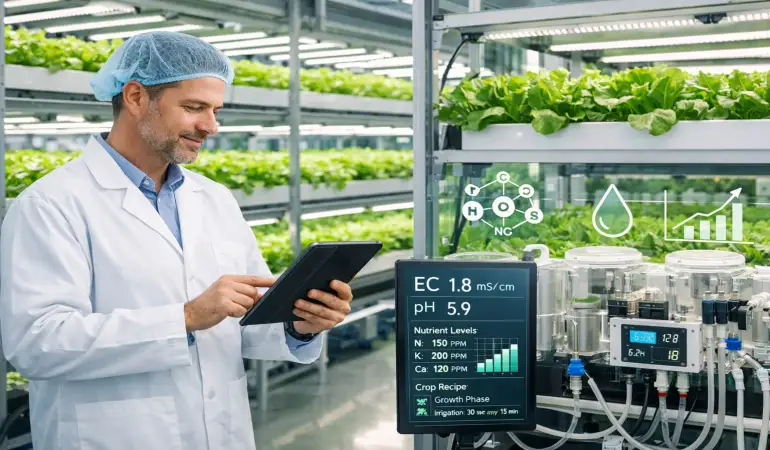
In vertical farming, plant nutrition is not a secondary factor - it is one of the most critical variables.
Growers must precisely control EC, pH, nutrient composition, and water quality to achieve stable yields.
👉 Explore top CEA and vertical farming nutrition consultants
These experts help optimize nutrient strategies, reduce waste, and improve crop performance in commercial operations.
Infrastructure: Climate Control and System Stability
Vertical farming systems depend on tightly controlled environments, including temperature, humidity, airflow, and CO2 levels.
👉 Explore climate control technologies in vertical farming
The Vertical Farming Ecosystem
Vertical farming is supported by a global ecosystem of companies and service providers.
👉 Browse vertical farming companies worldwide
- Indoor farms and commercial growers
- Technology providers
- System integrators
- Consultants and advisors
Work With Experts
Entering vertical farming requires technical expertise and careful planning.
👉 Request a vertical farming consultant
Consultants can support system design, crop optimization, and operational efficiency - reducing risk and improving outcomes.
The Shift Toward Local Food Production
The global food system is shifting from efficiency to resilience. Local production is becoming increasingly important to reduce dependency on unstable global supply chains.
Vertical farming enables food production directly where demand exists - in or near cities.
Conclusion: A System in Transition
The food crisis in 2026 is a structural transformation driven by energy markets, fertilizer dependency, and geopolitical instability.
Vertical farming is not a replacement for traditional agriculture - but it is becoming a critical component of a more resilient food system.
The question is no longer whether the food system will change - but how fast adaptation will happen.